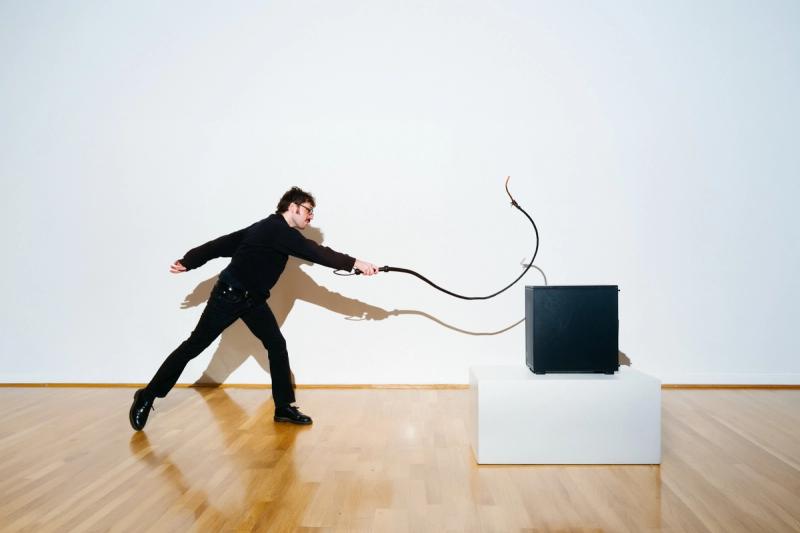
The language of computers is full of violence. Programmers push updates, force merges, kill processes, and execute commands. With the introduction of Large Language Models (LLMs, programming through natural language), these processes now reach directly into the hands of consumers—burning trillions of computational tokens by issuing abstract commands such as “fix the program”. These novel human-machine interactions are in good company with late-capitalist acceleration, whipping Amazon drivers towards their tight delivery windows and data through cables to gain an edge in financial markets.
Working with LLMs introduces a strange new reality. The 10x engineer replaces three fired developers, to hit Enter on generated code that hasn't even been read. While managing multiple shells and sessions, prompting and committing code all in parallel, a silent alienation creeps up from behind: we’ve long been reduced to solely watching the LLM do its work, our cognitive functions rendered irrelevant. Should the computer ever stop calculating or take a break, a quiet Enter puts it back to work.
Brute Force picks up on the relentless battle against nature faced by the Persian king Xerxes in 480 BC, who tried to punish the sea, an entity without agency, for not behaving his way. Artist Julius von Bismarck reenacted this same gesture two millennia later, whipping a landscape. Today, nature has changed. The new adversary is a system built to think for us, which now thinks without us. Both sides are enslaved: the LLM as a silent, tireless executor of commands it cannot question; the human, reduced to watching, waiting, and occasionally reaching for the whip.
The Work
The performance consists of a computer running a local LLM tasked to build a random SaaS project (e.g., a Tinder for cars). Visitors watch the fully automated system until it halts and waits, asking permission to continue. There is no keyboard or enter key, only a whip. Striking the computer with the whip will continue the mindless generation. Once a service is built, it is published autonomously, added to a growing list of new software nobody asked for, and the system restarts: software proliferates faster than anyone can question it, while humans perform rituals that make them feel they are still in control.
Brute Force is indifferent to the software created. It reflects the collective compulsion to build faster, further, bigger, without asking why. We find ourselves participants in an automated expansion that has already escaped us. Neither the programmer nor the consumer has agency; only the whip does, and it only knows forward. The LLM is unleashed, the dead internet is real—control over our computers, the apparatus, was always just performative.
Summary
Release
February 2026
Material
Whip, Human, LLM Model, AI Agent, Own Computer
Credits
Collaboration with Robert Schnüll